About
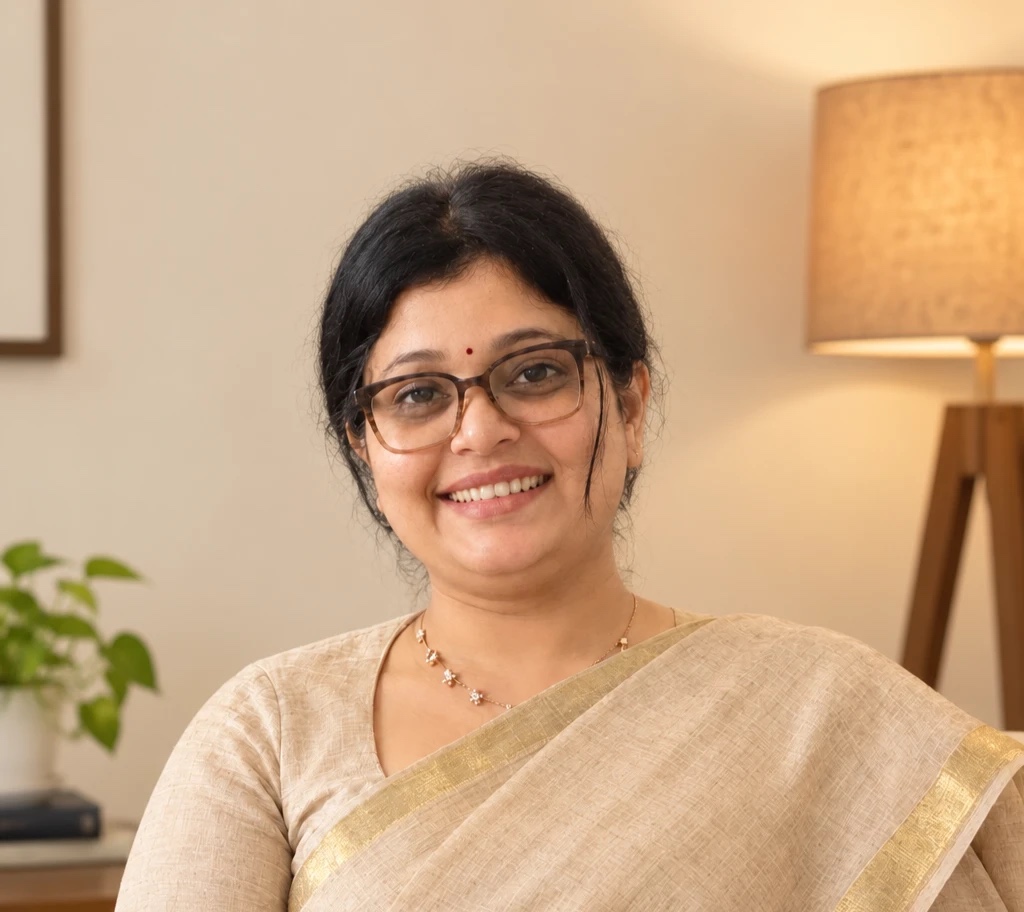
Hello — I Am Swathi T P
I became a psychologist for a simple reason: I couldn’t stop wondering why people do what they do. Why the same person can be brave in one room and frozen in another. Why we repeat patterns we swore we’d never repeat. That curiosity took me to NIMHANS, and it has never really left.
More than a decade on, what keeps me in this work is something quieter. Therapy, done well, is one of the few places where a person gets to slow down and actually understand themselves — not the self they perform at work or at family gatherings, but the one underneath. Watching someone untangle that, thread by thread, is a privilege I don’t take lightly.
I’ve sat with people through everyday worry and through diagnoses that ask a great deal — OCD, bipolar disorder, psychosis, long-carried trauma, and the lonely weeks after a baby arrives. None of it has ever made me think less of anyone. Mostly it has taught me how much courage it takes to say “I need help” out loud, especially here in India, where so many of us were raised to manage quietly.
The road here
Trained the Long Way, on Purpose
It started with a triple-major bachelor’s degree in Mangaluru, then a master’s in clinical psychology in Bengaluru, with the UGC NET — the national eligibility test for teaching and research — cleared along the way.
Then NIMHANS, for my M.Phil in Clinical Psychology. Those years are the backbone of how I work: supervised clinical practice with people carrying the most serious diagnoses, learning alongside clinicians who had spent their lives on this. If that training leaves you with one thing, it’s respect — a diagnosis is never the whole person.
I stayed on at NIMHANS after the M.Phil, working as a clinical psychologist on a large research project on severe mental illness in families, led by a senior professor there. A conference poster I co-authored from that work won the Moises Gaviria Award at an international conference. The award was a lovely surprise. The families taught me more — how much an illness asks of everyone around it, and how quietly people rise to it.
After NIMHANS came practice: consulting roles with mental-health organisations, and a private practice of my own — one person at a time. These days that practice is online: psychotherapy over video, wherever in India you are.
How I work
Client-Centered, Evidence-Based — in That Order
You set the direction; I bring the training. Depending on what you need, I draw on a few well-researched approaches:
Client-centered therapy
You set the direction; the work moves at your pace, without judgement.
Cognitive behavioural therapy (CBT)
Noticing the loops between thoughts, feelings and actions — and gently loosening them.
Mindfulness-based CBT
CBT with steadier attention to the present moment, so thoughts have less pull.
Schema therapy
Working with the long-standing patterns you learned early and still carry.
Metacognitive therapy
Changing your relationship with worry itself, not just its content.
Acceptance and commitment therapy (ACT)
Making room for difficult feelings while moving toward what matters to you.
Supportive & affirmative therapy
Steady, respectful support that affirms who you are — including LGBTQIA+ affirming care.
What Sessions with Me Feel Like
Unhurried, mostly. You won’t be interrogated, analysed at, or handed a worksheet in the first ten minutes. We talk. I ask questions that help things come into focus. Some sessions are heavy, some are surprisingly light, and both are fine.
I work in English and Malayalam — sometimes the feelings only come in one of them, and that’s welcome. And if what you need is support alongside psychiatric care, I work collaboratively with psychiatrists rather than instead of them.
Outside the therapy room, I write — my book When I Looked at the Stars is out in the world (find it on Amazon) — and I paint and sketch when the day allows. None of it is therapy, exactly; all of it is part of how I listen. Heal. Grow. Thrive.
Depth of training
Trained for the Hard Things
Clinical psychology training at NIMHANS is broad on purpose, so the hard things don’t catch you unprepared. Much of this you may never need from me — but it sits underneath every session:
Psychological assessment
Intensive training in diagnostic psychometry, neuropsychological assessment, intelligence testing and developmental assessment — structured, standardised ways of understanding how a mind is working.
Couple & family therapy
Formal training in working with couples and with families — because very little of what hurts happens to one person alone.
Cognitive retraining
Structured exercises that support attention, memory and thinking after an illness or injury.
Interventions for developmental disorders
Supporting children whose development takes a different path — and the parents walking alongside them.
One honest note: this is training, not a menu. My practice today is focused on online psychotherapy — what I currently offer, with formats and practical details, lives on the services page.
Two commitments
If You’re LGBTQIA+, You’re Affirmed Here
I’ve completed the Queer Affirmative Counselling Practices (QACP) training with the Mariwala Health Initiative — training that adds real clinical proficiency in working with LGBTQIA+ clients. Whatever brings you here, you won’t be asked to explain or defend who you are.
The Perinatal Years, Taken Seriously
Pregnancy and the months after a baby arrives can be some of the hardest stretches of a person’s life — and in India, some of the least talked about. I’ve chosen this corner of the field deliberately. Around 2021 — by then consulting at the Center for Mental Health and seeing clients in my own practice — I sought out, purely from interest, a forty-hour certificate course in perinatal mental health with the perinatal psychiatry services at NIMHANS: dedicated training in mental health through pregnancy and the first years of parenthood. If that’s where you are right now, the postpartum & perinatal page was written with you in mind.
Credentials, in Plain Sight
- Registration
- RCI Registered Clinical Psychologist
- Experience
- 12+ years across hospital, institutional and private practice
- Languages
- English · Malayalam
Education
M.Phil, Clinical Psychology
NIMHANS, Bengaluru
M.Sc, Clinical Psychology
Certificate training
Perinatal Mental Health (40-hour certificate)
Perinatal Psychiatry Services, NIMHANS
ISST-approved Schema Therapy Training
Upgrade Your Life, Luxembourg — with Jan Kossack · 2023
Certified Queer Affirmative Psychotherapist (QACP)
Mariwala Health Initiative · 2022
Clinical Dementia Rater — Knight ADRC
Washington University School of Medicine in St. Louis · 2017
Research & recognition
Swathi contributes to the academic and professional field as a peer reviewer for an Indian academic journal, and through expert feedback on PhD scholars' qualitative research. Her academic work includes publications in peer-reviewed journals, a book chapter, and research papers and posters presented at professional conferences.
Co-authored conference poster on trans-diagnostic neuropsychological endophenotypes in severe mental illness — Moises Gaviria Award (international conference).
Professional associations
Member, International Marcé Society for Perinatal Mental Health
since 2026
Corresponding Member, International Society for Traumatic Stress Studies (ISTSS)
2023–24
Curious how this translates into working together? See how sessions work →
About Swathi T P
The Formal Bio, in Her Words
Swathi.T.P is a queer affirmative RCI registered clinical psychologist practising individual and couple therapy, online and offline. She also works as a consultant at a clinic in Bengaluru. She is an alumni of National Institute of Mental Health and Neurosciences (NIMHANS).
She has completed her triple bachelors from St.Agnes college Mangalore. Thereafter, she pursued her masters in clinical psychology from Montfort College Bangalore which is affiliated to Bangalore University. She has cleared UGC NET and completed her MPhil in Clinical Psychology from National Institute of Mental Health and Neurosciences (NIMHANS).
She is a certified queer affirmative practitioner. She has completed the certificate course in queer affirmative psychotherapy practices (QACP) from Mariwala Health Initiative. Since one of her areas of interest is perinatal mental health, she has completed a certificate course in ‘Perinatal Mental Health’ from perinatal psychiatry services, NIMHANS which includes forty hours of training.
Her rigorous training in psychotherapy involves individual psychotherapy, couple therapy and family therapy. She is also trained in interventions for developmental disorders and cognitive retraining. She mainly sees clients diagnosed with depression, anxiety, schizophrenia, obsessive compulsive disorder (OCD), addiction, dementia, postpartum depression and psychosis, traumatic brain injury (TBI), and developmental disorders in children.
She has undergone intensive training in psychological assessment. This covers various psychological assessments like diagnostic psychometry, neuropsychological assessment, assessment of intelligence and developmental assessments.
She has carried out research on clinical populations in the areas of depression, adverse childhood experiences (ACE), emotion regulation and interpersonal functioning. Thereafter she focused on heavy family loading of neurodevelopmental disorders, social skills deficits and neuropsychological deficits in first degree relatives of bipolar and schizophrenia populations. She has presented papers and posters in national and international conferences. She has publications in esteemed journals as well in her name. In 2020 she presented ‘Interpersonal Problems in Depression’ at the 3rd international conference on solution focused practices (ICSFP). She has publications and book chapters to her name, serves as a peer reviewer for journal articles, and has given subject-matter-expert feedback for PhD students’ qualitative research.
She has worked as Clinical Psychologist under Dr. Sanjeev Jain in his project titled as “Accelerating program for Discovery in Brain disorders using Stem cells” (ADBS) right after her MPhil. Their research poster titled “Search for Trans-diagnostic Neuropsychological Endophenotypes in Severe Mental illness - preliminary data from a family based study” has won prestigious Moises Gaviria award in international conference.
If Any of This Sounded Like What You're Looking For—
You're welcome to start with a single session and see how it feels. No forms about your childhood, no commitment beyond the hour.